











Talk to Us
Schedule a quick meeting with one of our experts.


Every enterprise IT team is sitting on a mountain of data. Metrics, logs, traces, and alerts firing faster than any team can read them. And yet, when something goes wrong at 2 a.m., the first few questions are still the same ones they have always been: What’s changed? What’s impacted? What do we do next?
The problem is not a lack of data. The problem is that the tools enterprises rely on have evolved in layers, each solving a real problem, each leaving a gap that the next layer was meant to close. Most organizations have invested heavily across multiple of these layers. And many organizations still struggle to translate visibility into operational action.
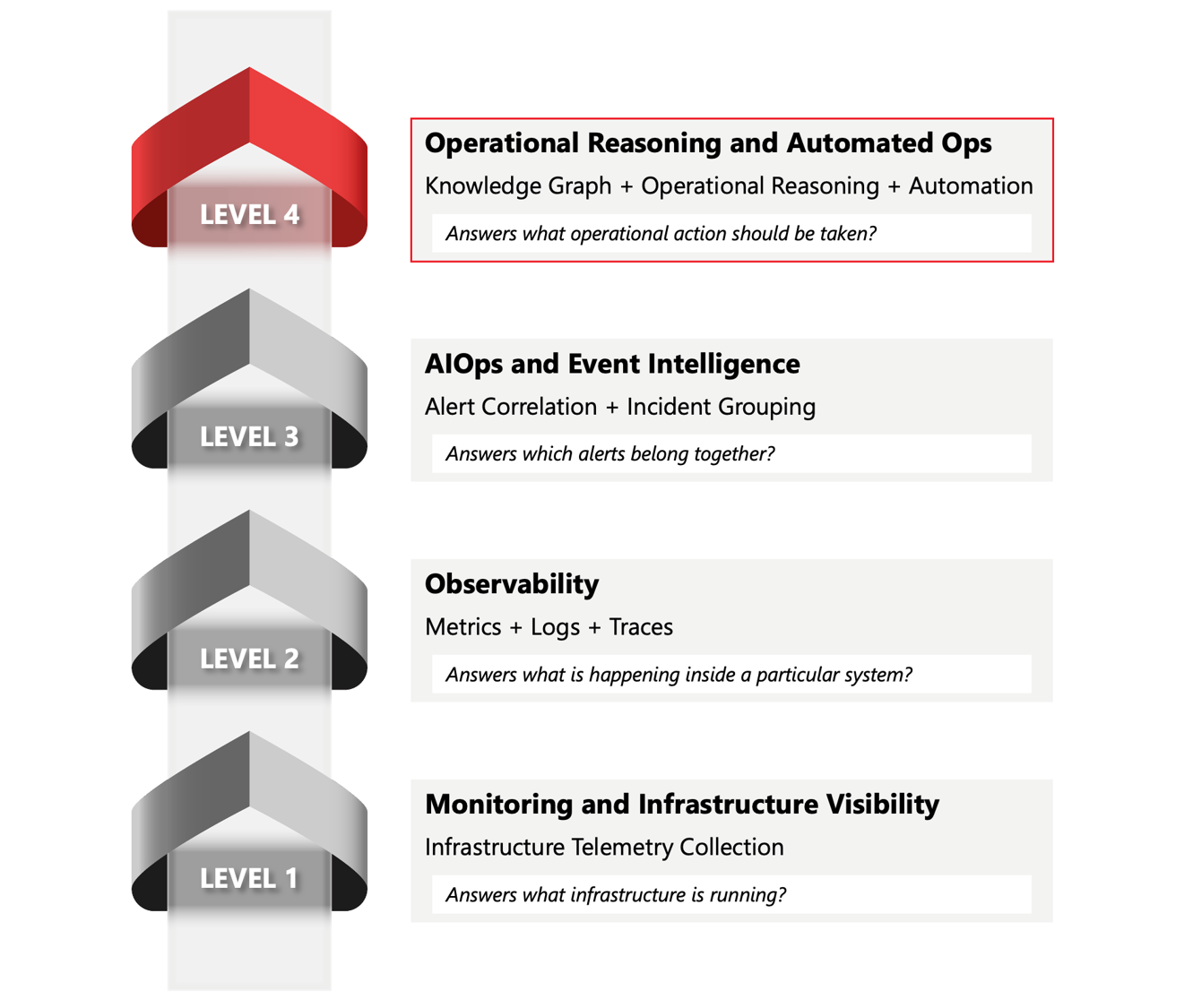
Every operations journey starts here. Monitoring tools like SolarWinds and LogicMonitor answer the question: What infrastructure is running?
They collect telemetry, check whether services are up or down, and alert when thresholds are breached. Essential, and they will remain so. But their design is component-centric: each tool watches its own domain. Network, servers, applications, each observed in isolation. Teams are left stitching together information from multiple dashboards, chasing alerts across siloed systems.
The gap monitoring leaves: visibility into individual components, but no understanding of the system as a whole.
Observability platforms like Dynatrace, Datadog, and Splunk moved the conversation to what is happening inside the system. By combining metrics, logs, and traces, they gave operations teams genuine context: the ability to follow a request across ten microservices and pinpoint exactly where it broke.
This was a real leap. But as environments grew more complex, signal volume grew with them. Alert fatigue became endemic. The "watermelon effect" persisted: dashboards showing green SLAs while the actual user experience was anything but. Observability gave teams better data. It did not give them fewer decisions to make.
The gap observability leaves: rich system telemetry, but no way to separate signal from noise at scale.
AIOps platforms like Moogsoft and BigPanda addressed the noise problem directly, applying machine learning to correlate alerts into coherent incidents and surface what actually needs attention: Which alerts belong together?
Reducing 50,000 alerts to 200 incidents is genuinely valuable. Most AIOps platforms excel at correlation and pattern detection, but correlation is not operational reasoning.
They group alerts based on patterns. They do not know which service dependencies are critical versus optional, whether a degraded component is protected by redundancy, or whether the business is actually at risk. Knowing that 47 alerts belong to the same incident is useful. Knowing whether that incident will cause a customer-facing outage in the next 15 minutes, and knowing what to do to prevent it, is a different problem entirely.
A 2026 joint research by Microland and Everest Group found that enterprises use an average of six to seven operations tools and still lack an operational system of context. Despite investment across all three layers, 52% of enterprises cite inadequate operations foundations as their single biggest blocker to scaling AI.
The gap AIOps leaves: better incident grouping, but limited operational reasoning and limited ability to safely drive governed automated action.
This is the layer that the first three levels were always missing. This is the layer enabled by Microland’s Intelligent Operations framework, powered by intelligeni, an operational reasoning platform.
The question Level 4 answers is the one that matters most: What should we do?
intelligeni builds a knowledge graph that models not just topology but operational relationships: dependency strength, redundancy capacity, and how infrastructure health maps to business outcomes. This is what allows it to reason about the state of the system, rather than simply observe it.
When an alert fires, intelligeni does not group it. It places it in context. Consider what that looks like in practice: monitoring tells you a server is at 94% CPU; observability tells you that correlates with elevated latency on your payments service; AIOps tells you this alert belongs to a cluster of 23 others. intelligeni tells you the affected server is the secondary node in an N+1 cluster, the primary is healthy, the payments service is not at risk, and the recommended action is load rebalancing, which it can execute automatically within your approved change window.
Equally important, automated actions occur within governed operational boundaries. Remediation workflows align to approved change policies, role-based permissions, and human-in-the-loop escalation models, so enterprises can increase automation safely without sacrificing operational control.
That shift, from correlation to reasoning, from visibility to action, is what makes intelligeni a different category of system. Not another observability platform. Not another AIOps engine. An operational reasoning platform that sits above the existing stack and makes it operationally useful. It complements, not replaces, existing investments in Dynatrace, Datadog, Splunk, or Moogsoft.
Technology alone does not create automated operations maturity. Enterprises must also operationalize telemetry engineering, automation governance, service modeling, and continuous optimization processes. Microland’s Intelligent Operations approach combines the intelligeni platform with ongoing operational engineering and managed lifecycle services to help enterprises evolve toward higher levels of operational maturity.
The joint Microland-Everest Group research on autonomous operations describes this target architecture: the most capable operational platforms integrate sensing, reasoning, and action into a single continuous loop, using knowledge graphs and agentic AI to execute bounded, governance-compliant remediation. intelligeni is built to that specification.
79% of AI pilots have not advanced to production, and the primary reason is not model quality. It is operational fragility. AI-enabled and agentic operating models place extraordinary demands on infrastructure: high availability, continuous observability, and the ability to respond to degradation before it cascades. Enterprises that cannot reach Level 4 will find their AI ambitions constrained by the same fragmented, reactive operational model they have been trying to move beyond for years.
Early movers embedding operational reasoning into their stack are already realizing 25% to 35% incremental savings alongside faster resolution and stronger resilience. The gap between them and organizations that are still at Level 1 or 2 is widening.
The first three levels are necessary. They are not sufficient. The journey toward increasingly automated, and ultimately more autonomous operations requires a reasoning layer. That is what intelligeni was built to provide.
For a comprehensive view of what autonomous operations for enterprises will look like in practice, Microland's research with Everest Group, "Architecting Autonomous Operations: Powered by AI and a Platform-led Technology Fabric," is available here.