











Talk to Us
Schedule a quick meeting with one of our experts.



Enterprise cloud estates have expanded faster than the operating models built to manage them.
Workloads now span private data centers, Hyperscalers and edge environments, while observability, security controls and cost accountability often remain fragmented.
The result is a widening CloudOps maturity gap. Many organizations have adopted cloud at scale but have not yet engineered the intelligence needed to operate it effectively.
This creates a dangerous midpoint. Cloud environments are too distributed and complex to manage manually yet not automated enough to run autonomously.
Development and release velocity is also accelerating sharply; where an engineer might once have made one or two releases a day, agents now build, test and deploy at machine speed, and every change carries the potential to disrupt a service.
Operations teams face alert fatigue, cost sprawl, compliance drift and engineering displacement, with valuable engineering capacity consumed by routine infrastructure management.
The resulting volume and pace of change is exceeding what human teams can safely analyze, decide upon and act on.
Managing and stabilizing the environment must therefore become agentic. Attempting this manually is not only difficult and costly but also leaves the estate unprepared for the future model of operations.
This is why autonomy is no longer optional. Autonomous operations are an imperative, and one that is already upon us rather than a distant, future consideration.
Closing this gap requires an integrated architecture that enables the cloud estate to detect, decide and respond.
An enterprise-wide observability fabric connects telemetry, logs, traces, anomaly detection and event correlation, helping to identify the signals that precede incidents rather than simply reacting after business impact occurs.
It is the foundational layer, because every downstream decision and action depends on what the estate can sense.
Infrastructure as Code makes environments repeatable, traceable and auditable. Well-architected landing zones can encode security baselines, networking, identity and compliance requirements from the outset.
Policy as Code translates governance requirements into machine-readable rules that can block non-compliant deployments, identify configuration drift and initiate remediation.
Orchestration of deterministic actions provides the diagnostics and remediation that resolve issues rather than merely changing configuration.
Where Infrastructure as Code adjusts the desired state, this layer diagnoses and fixes problems through deterministic, repeatable actions. It applies equally across any environment, whether containers, cloud or otherwise, closing the loop between sensing and response.
Observability, Infrastructure as Code, Policy as Code and deterministic actions are increasingly orchestrated by an agentic layer – an AI brain” that senses, decides and acts across the estate within defined boundaries.
The value comes from integrating these capabilities. Observability without intelligence produces insight without action. Infrastructure as Code without observability creates control without visibility. AI without governance accelerates decisions without sufficient accountability.
The defining shift from automated to autonomous operations is the ability to make appropriate operational decisions continuously.
Traditional rule-based automation addresses scenarios anticipated in advance. Agentic AI can extend this model by correlating signals across infrastructure, application and security layers, reasoning over unfamiliar situations, and initiating suitable workflows within defined boundaries.
This intelligence supports self-healing infrastructure, predictive incident management and continuous performance optimization.
A deteriorating service can be restarted, traffic rerouted or capacity adjusted before users experience disruption. Resources can be right sized according to utilization patterns, bottlenecks identified before thresholds are breached, and deployment configurations tuned to maintain service commitments.
Microland offers one example of how this model can be operationalized. Our intelligeni CloudOps approach applies agentic AI to monitor cloud estates, correlate operational signals and execute remediation workflows.
We could achieve 35 per cent reduction in incident volume and Mean Time to Resolution across Microland enterprise deployments using AI-driven predictive operations and automated remediation.
The broader lesson for organisations is that AI delivers meaningful operational value when it is integrated into the architecture and operating model, rather than deployed as an isolated technology layer.
Autonomy cannot mean unconstrained automation. FinOps, security and compliance must operate as active, preventive controls.
Pre-deployment cost gates can assess financial impact before workloads enter production, while real-time anomaly detection can identify unexpected cost acceleration. Security policies can enforce least-privilege access and approved network configurations. Continuous compliance checks can maintain an auditable record of changes and remediate deviations earlier.
The human operating model is equally important. Routine execution can move to automation, while engineers and architects focus on resilience, product innovation, policy design and accountability.
Organizations must define clear boundaries for when systems may act independently, when they should recommend an action, and when human approval is mandatory. These boundaries should evolve as operational maturity and confidence increase.
Autonomy also introduces an entirely new dimension of governance. Until now, governance has concentrated on the environment itself. In an agentic model, organizations must also govern the agents that operate that environment. This is a distinct responsibility – supervising the AI that senses, decides and acts – and it will remain a fundamentally human accountability. Governance must therefore become continuous across both the environment and the agents managing it.
None of this happens automatically. Agents cannot operate an environment they do not understand, which is why organizations must deliberately make their estates autonomy ready, and do so progressively.
This is where ontology becomes essential.
Observability and Infrastructure as Code describe what is happening, but they do not convey what it means for the business. Moving from raw telemetry to a knowledge graph adds relationships with meaning; layering an ontology on top adds business and situational understanding.
Just as important is the tribal knowledge acquired by engineers which must be made available to agents through documentation, retrieval and similar means. Making an environment autonomy ready in this way is what allows agents to be trusted with genuine autonomy.
For IT leaders, the autonomous cloud is not simply a technology destination. It is architecture, governance and operating-model agenda. Moving in the right direction requires a controlled progression:
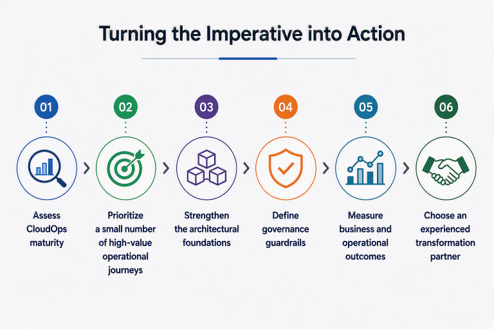
Organizations that move deliberately, demonstrate value through focused use cases and scale within trusted guardrails will be better positioned to turn cloud complexity into operational advantage.
This cloud-focused perspective builds on the broader vision outlined in Microland and Everest Group’s Architecting Autonomous Operations: Powered by AI and a Platform-led Technology Fabric, translating its call for unified, AI-driven operations into the specific architectural and operating imperatives required for an autonomous cloud.